Staffing companies are a pivotal aspect of the present labor market, since they connect employers with the desired talents and create income through diverse business models. It is a well-known fact that many entrepreneurs and job seekers are puzzled: what is the secret? How do staffing companies make money? The answer can be found in the staffing agency’s different income methods: the main features being temporary staffing, permanent placement, and executive recruiting, as well as niche industry applications. Recruiting fees, client onboarding fees, contingent fees, and staffing margin control are some of the elements that add up to the sustainable income streams for employment agencies which, in turn, offer valuable staffing solutions.
How Do Recruitment Agencies Make Money?
Temporary Staffing Services

Temporary staffing is a kind of workforce solution and is one of the first and most widespread in the measured labor market. Employers make use of these solutions to address the seasonal need issue, fill the gaps due to employee leave, and so on.
Hourly Markup Model
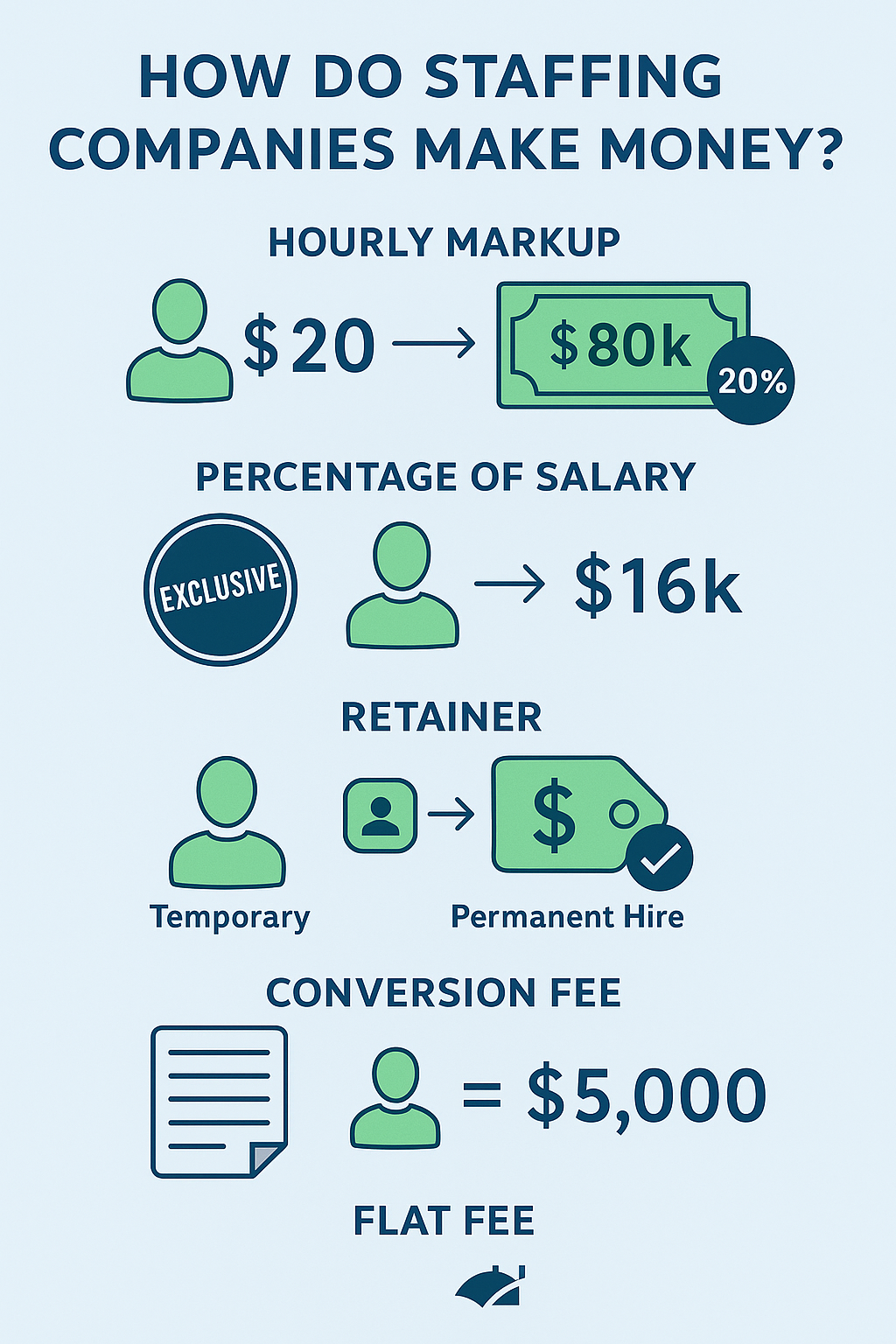
In this model, the staffing company charges the employer an hourly rates that not only covers the worker’s wage but also adds a markup. Thus, for instance, if the worker gets $20 per hour, the staffing agency can bill the employer $28 per hour. The $8 difference takes care of the payroll outsourcing, compliance consulting, background check fees, credentialing services, and the agency’s profit margin. The hourly markup that this model offers the staffing agency is a method to earn flexible revenue while keeping the costs for the client predictable.
On top of that, staffing agencies earn through vendor management fees, and managed services, and have onsite payroll services as part of the package. These workforce management solutions not only make the hiring process of the employer smoother but they also involve additional staffing agency fees and increase agency profitability.
Benefits and Challenges
The main gains of temporary staffing are building client partnerships, providing workforce analytics services, and the fast path of hiring. To promote reiteration business, agencies frequently but contingent fees and volume staffing discounts. The tough part is margin control, as in the quest to equalize staff hours against the market rate benchmark. Agencies have to test compliance fees, handle payroll recruitment process outsourcing, and onsite staffing costs, which in turn, will affect their profitability if they are not treating them responsibly.
3 Smart Revenue Streams Every Recruiting Firm Owner Should Know
Permanent Placement Services

Permanent placement staffing, or also known as direct hire, is the second major resource of income for the staffing company. Unlike temporary staffing, permanent placement involves looking for candidates to fill long-lasting positions.
Percentage of Salary Model
Most agencies that rely on such a recruitment strategy follow the percentage of salary model. To wit, the staffing agency revenue models charges a fee which is often 15% to 30% of what the first-year salary of the candidate will be. For instance, if a candidate earns $80,000 per year, the agency can make anywhere from $16,000 to 24,000 for that specific recruitment.
This model is mostly preferred due to its extensive application in industries with higher skill level demands since the recruitment strategies processes involve such things as resume screening, sourcing commissions, compliance consulting, and also exclusive candidate access.
Advantages and Considerations
The advantages of permanent placement are that the client can be sure of placement bonuses conditions, can get a hiring bonus, and the contingent revenue models that will be stable. Clients enjoy speedy operations with solutions that reduce costs in hiring and getting specialized talent pipelines. On the contrary, agencies are at risk if they happen to have candidates who leave earlier than expected resulting in situations like replacement guarantees or renewal commissions. Agencies need also to make investments in such things as acquiring talent and branding the employer should be competitive in the direct hire market.
Retained Search & Executive Recruiting
Executive recruiting is one of the high revenues in staffing services because it lays emphasis on top leadership vacancies.
Retainer Agreements
In the retained search case, customers must pay the recruitment strategies resume beforehand to be the only company with access to the exclusive candidates. The above-mentioned agreements include the development of sourcing strategies, the outsourcing of recruitment process fees, the provision of workforce analytics services, and compliance testing fees. Retainers guarantee a continuous flow of income and ensure that the agencies dedicate the most resources to handling the senior roles.
Recruiting incentives like the guaranteed placement bonus, hiring bonuses, and supplier partnerships are the usual cases in this area, especially where agencies are seeking for rare executive talents.
High-Level Placements
Executive recruiting is primarily about C-level, vice presidents, and other specialized leadership roles. Because these positions may have a substantial impact on the whole organization, agencies charge higher agency fees. The search models can involve recruitment fees, market rate benchmarking, and even client profitability analysis to align with the client’s needs. By assisting in executive recruiting, staffing companies foster high benefits to their clients and they also make useful connections with business leaders in different sectors.
Temp-to-Perm Conversions
Temp-to-perm staffing is a mixed mode of working where the candidate first is eligible as a temporary employee and then gets the chance to be a permanent one.

Conversion Fees
When the employer finally decides to offer a full-time position to a temporary employee, staffing agencies charge a conversion fee. The fee may be set as a flat recruitment fee, a percentage of the employee’s salary, or hours worked. Temp-to-perm conversions create opportunities for the agencies also to earn renewal commissions as well as contingent fees.
Client Benefits
A client can “try before buying” which is a great advantage for them as they can assess the suitability of a candidate in the workplace such as their performance, mutual cultural fit, and general capabilities and only then decide if to proceed for a direct hire. Besides, employment solutions earn while they help the client in a way that they hire without any risk. The handling of workforce management is made easier, while both temporary guaranteed placement and permanent placement yield agencies predictable revenue streams.

Flat Fee Staffing
Flat fee staffing industry is a new trend where employment agencies target specific industries to serve for and provide cost predictability which is a source of revenue.
Niche Industry Applications
Flat fee staffing industry is a very effective model in the niche industries logistics, health care, and IT. In the semi-truck transportation industry, for example, the use of flat fee staffing is widely embraced by the agencies to recruit CDL drivers, fleet managers, and logistics coordinators. Contract staffing, direct hire fees, and predictable recruitment services at a fixed price are the ways that the agency gains contingency revenue while keeping negotiation time down. Trucking companies benefit from workforce planning, talent pipeline monetization, and sourcing strategies tailored to the industry. Agencies will contract staffing and direct hire fees as well as offer predictable recruitment services on a fixed contract, thus gaining revenue, without the complexities of negotiation.
Industry specialization fees can be included in flat fee packages as well. This kind of service like semi-trucks, compliance consulting, credentialing services, and background check fees would be required to meet state and federal regulations for drivers. So, by selling these services, staffing agencies not only provide a steady contingency revenue stream but they also foster their customer connections.

Predictable Revenue Streams
Flat fee staffing is a model where clients are charged a fixed cost for recruitment, regardless of the hours worked or the salary of the candidate, which allows them to make a full budget upfront. Agencies attain stability through assured placement fees, onsite staffing packages, and workforce analytics services. This model also supports the expansion of workforce solutions, thus, it is a viable option for hiring bonuses in bulk for industries that require constant staffing.
Conclusion
So, how do staffing companies make money? The answer is embedded in the diverse business models of staffing agencies, which are devised to satisfy various client needs. Temporary staffing that goes with hourly markup models, to permanent placement that has a percentage of salary fees, agencies make a successful combination of recruiting strategies with workforce management to make their profits. Executive recruiting that goes with retained search turns in retainer agreements and placement of high-level staff, while temp-to-perm conversions add flexibility through client conversion fees. Flat fee staffing, which is associated with the introduction of niche industry applications and predictable revenue streams to be used in specialized areas such as semi truck logistics, is one more point in the discussion.
Agencies are the ones that lead in the recruitment business by providing staffing solutions which include fees for client onboarding, sourcing commissions, workforce analytics services, and also compliance consulting issues. Whether they are through contract staffing, recruitment process fees, or talent pipeline monetization, staffing companies are seen to adapt according to the changes in hiring processes. Agencies make sure their long-term client benefits and sustainability not only with recruiting incentives, industry specialization fees but also client profitability analysis.
In the field of staffing, where the competition is very stiff, successful employment agencies capitalize on their skills in recruitment services, workforce solutions, and staffing agency fees. Mixing temporary, permanent, and niche models, among other successful strategies, ensures both client partnerships and a guaranteed placement revenue stream. Therefore, ultimately, staffing companies pocket profits through expense-efficient, compliant, and reliable workforce solutions provided to employers that in return give predicted revenues to them.

About the Author