Basics about Box Truck Heights
Whether one is in logistics, moving services, or fleet operations, asking the question “how tall is a box truck?“ is a must. It is not merely part of the trivia game anymore having the right box truck dimensions is a prerequisite for safe driving and accident prevention and it also makes a huge contribution to planning routes logistics. For the drivers and fleet managers, it is critical to remember box truck dimensions both outside and inside when they are faced with the possibility of damage from overhead bridges, widened tunnels, and packed garages if not the proper clearance taken.
By the license of truck safety, the lowest passenger vehicle height is 9 feet. However, there are trucks whose height could go as high as 13 feet. For example, in terms of height various types of box trucks can differ greatly from small box trucks to medium-duty models in which to large trucks go roof space to ceiling space, and even the side door clearance. In this article truck height standards about trucks will be established, reasons for regulations concerning box truck height will be provided, and, last but not least, readers will learn practical solutions for drivers.
Average Box Truck Heights
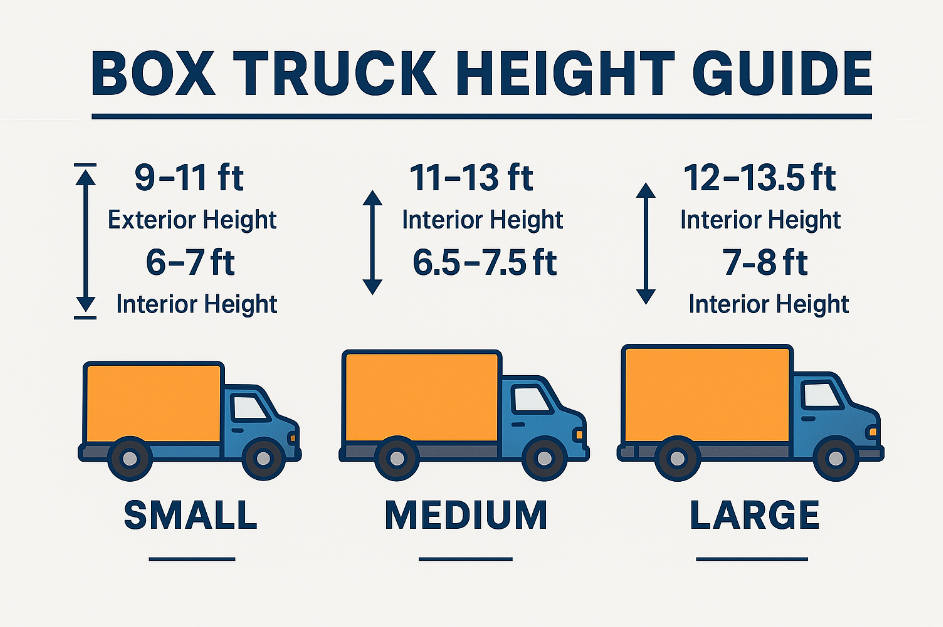
Box trucks are the most widely used commercial vehicles, and they are available in numerous models and layouts. Every one of them has its set of box truck specifications, although some patterns are evident across the industry. Among the smaller box trucks (10 to 12 feet long), the exterior height is generally in the range of 9 to 10 ft. Medium-duty versions (14 to 18 ft long) are mostly in the range of 10 to 11 ft long, and for the bigger trucks (20 to 26 feet), plus 13 gut crossing, they are grossly 12 or 13 ft in height. That would be the total vehicle height comprising both the cargo box and the chassis cab, hence the model height distinction can be broad even for two trucks with the same cargo length.
The interior cargo height is usually between 6’3” and 8’2” long. The cargo box ceiling height is of vital importance for businesses that have to deal with loading of tall items, and in the meantime, the door clearance height is sometimes slightly less than the full interior measurement, therefore, it is recommended to double-check the height data sheet prior to the purchase or rental.
Variations by Model and Manufacturer
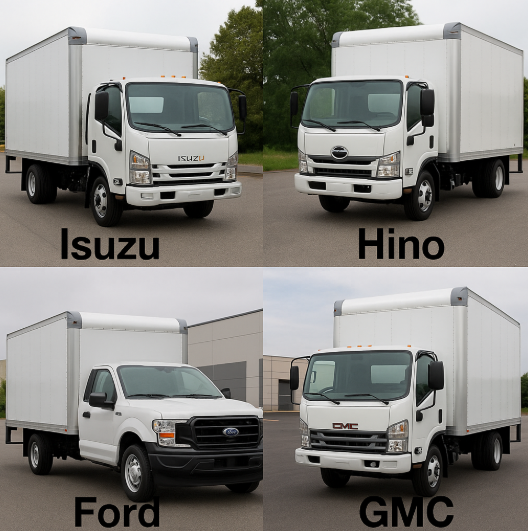
Despite the industry gives some rigid box truck height standards, the main determinant for these heights is the manufacturer and the body builder. For instance, Isuzu, Ford, GMC, and Hino have different height specifications for box trucks, and there are aftermarket changes that can alter the height to be either higher or lower.
This implies that there is no simple answer to the question of box truck height limits. In contrast, drivers and fleet owners have to utilize a height reference chart supplied by the manufacturer. Additionally, some box truck models deliver a lower cargo area height for easier loading, while other box truck models prioritize volume and thus raise the interior cargo height request. Hence a very full range of box truck height measurements exists which requires cautious taking of the right decision before sending the truck on a route that has possible clearance issues.
Common Box Truck Heights by Model Category
| Box Truck Length | Exterior Height Range | Interior Cargo Height | Typical Uses | Notes |
| 10–12 ft | 9–10 ft | 6’3”–6’6” | Small moves, urban delivery | Easier maneuvering, tighter box truck clearance |
| 14–18 ft | 10–11 ft | 7’–7’5” | Medium freight, retail delivery | Balance of cargo space and fuel economy |
| 20–22 ft | 11–12 ft | 7’6”–8’ | Furniture, appliances | Requires overhead clearance check |
| 24–26 ft | 12–13 ft | 8’–8’2” | Heavy freight, logistics | Approaches federal box truck height restrictions |
Regulation Issues
In the USA, there are box truck height regulations in place that are designed to diminish the risk of trucks hitting bridges, tunnels, utility structures, etc. These measures are such a minor part of the bigger problems related to safety and engine technologies.
State and Federal Height Regulations
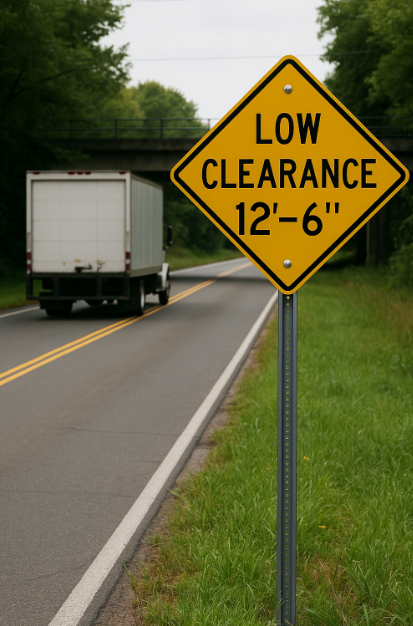
At the federal level maximum height restrictions for box trucks are six inches mainly 13 feet high. Some states permit up to 14 feet, but the majority have stricter regulations, which are dependent on whether it is a road. As a result, box truck height clearance is not just a technical characteristic but a question of the law too.
Each truck should be examined by its specific height limits of the state and should be marked on a height data sheet placed inside the cab for driver reference. Overlooking the box truck height limits can result in fines, liability claims as well as accidents that will damage both public infrastructure and private property.
Selected State Height Regulations for Box Trucks
| State | Max Legal Height | Notes |
| California | 14 ft | Urban routes often posted at 13’6” |
| Texas | 14 ft | Some rural roads restrict to 13’6” |
| New York | 13’6” | Low bridges common, strict enforcement |
| Illinois | 13’6” | Federal standard applied |
| Florida | 13’6” | Overpasses clearly posted |
| Arizona | 14 ft | Watch for canyon/bridge routes |
| Pennsylvania | 13’6” | Many tunnels at 13’0” clearance |
The Importance of Checking Clearance
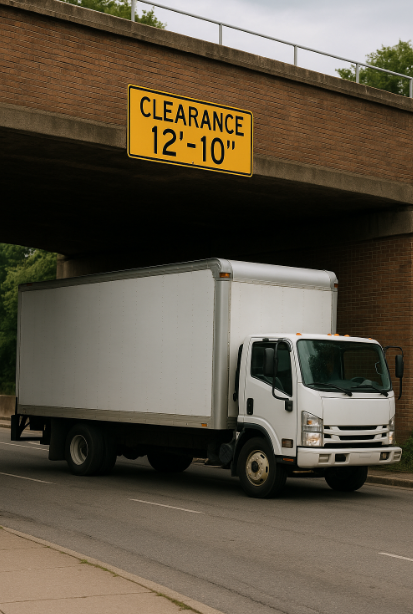
The most frequent cause of box truck crashes is the driver neglecting the ceiling clearance check. Parking garages, antiquated bridges, and underpasses with low ceilings necessitate constant vigilance on the driver’s part to keep track of the vehicle identification aspects, among them the height measurement way and the height tolerance.
An incorrect interpretation of the box truck height specifications, such as neglecting the count of roof-mounted equipment, may lead to collisions. For this reason, many fleet operators recommend establishing a height reference chart in all vehicles and train drivers so they always measure cargo height before departures.
Drivers Practical Tips
Measure Your Box Truck Correctly
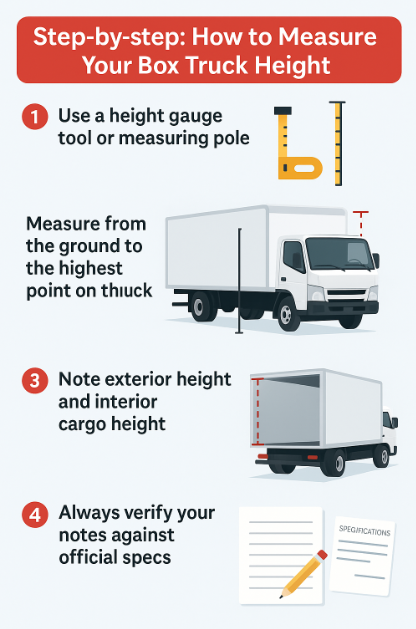
To prevent high cost errors, they should know how to apply a proper height measurement method. Start with a height gauge use tool or a measuring pole. Measure from the ground to the tallest point on the truck, including rooftop air conditioning units or auxiliary equipment. Note both the exterior height and the interior cargo height, since loading docks may ask for cargo area height.
The best method is to write down the box truck measurements in the form of a sticker on the dashboard that is visible all the time. This is a way to ensure that no one forgets about the routing. Your notes must always be compared with the manufacturer brochure, dealer spec sheet, or the official service documentation, which involves actual box truck specifications and engine calibration data.
Traveling in a Controlled Way
The best way to drive a box truck is to never even think of taking low clearance routes, but that is not necessarily the case. First of all, drivers will have to get into the habit of, for instance, performing the overhead clearance check before they enter the tunnels or the parking garages. Also, they can use online tools or GPS software to look out for routes that have low clearance warnings.
In case the driver finds it hard to choose a route, he/she has to stop and measure. For instance, if there would not be a door clearance height available at the posted site, the location can be measured using height gauge methods. One has to remember that as bridges and tunnels might sag, so the actual roof clearance could be below the official box truck height regulations.
Additionally, drivers should observe height tolerance stemming from truck suspension changes when it is fully loaded. Starting from an upgrade of just two-three inches, one can eliminate the risk of a truck bogging under an overpass.
Final Service
The question of how tall is a box truck might be seen as simple but indeed it is not as simple as it seems. Because of box truck height variations, model height differences, and modifications, no two trucks are all alike.
About the Author