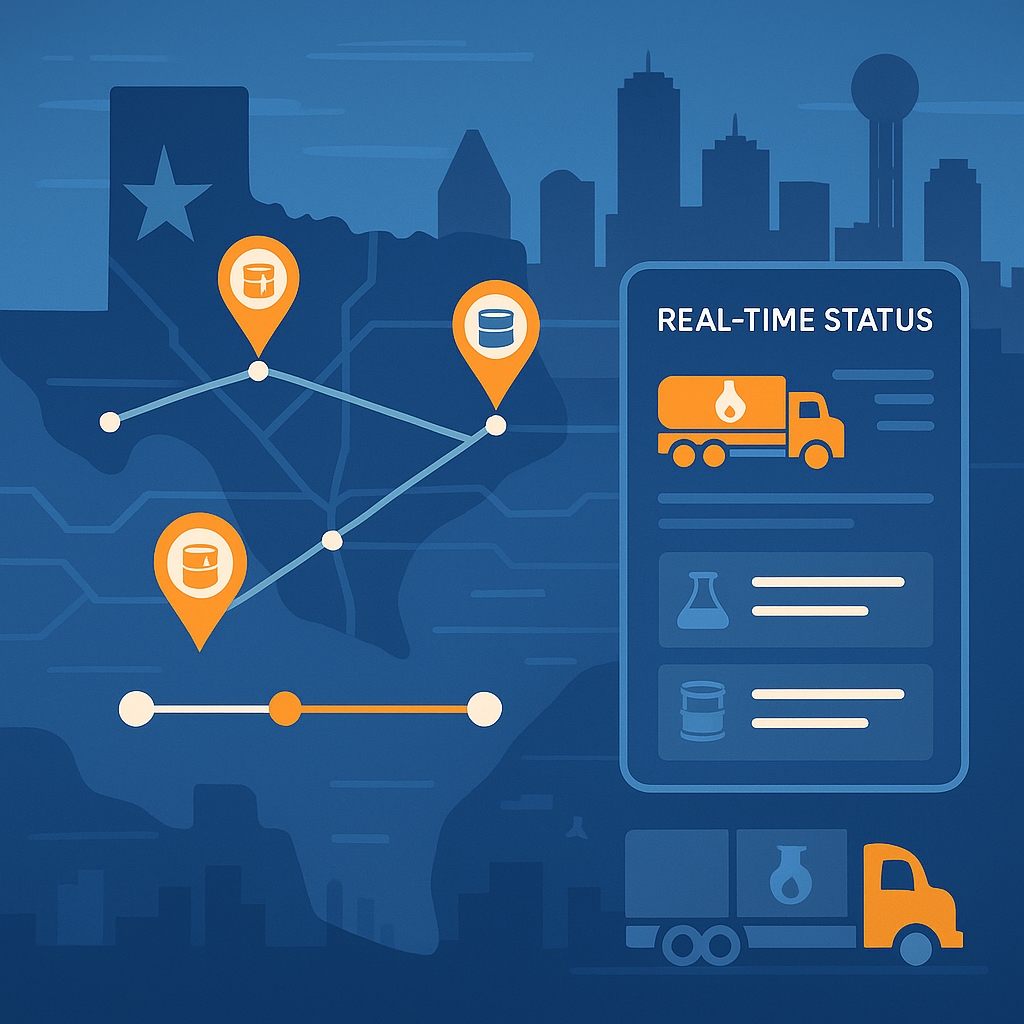
Greater trust in the chemical distribution market in Dallas largely goes beyond on‑time deliveries, it also requires making every shipment apparent, easier communication between shippers and carriers, and strict protections on fragile cargo. Since the chemical distribution industry often experiences safety hazards and heavy fines from miscommunication, delays, and regulatory missteps, the time has arrived for the companies to come up with potential chemical distribution tracking and Dallas transparent tracking solutions to remain relevant. The answer to this is found in the employment of the latest tools of the trade, the use of a secure portal access and real‑time status dashboards, and the issuance of all‑inclusive performance reports and audit visibility provide the opportunity for stakeholders to become champions of the shipper‑carrier trust and general operational excellence.
Included in the significant profile of the Dallas supply chain that has stakes in shipping chemical products are a few huge factors.
Dallas’s significance as a core chemical logistics center arises from its pivotal linking of the Gulf Coast refineries, Midwest manufacturers, and retailers across the country. The chemical industry is safety‑sensitive equipment, hazardous materials, and rigid EPA and DOT regulatory rules and thus it does not allow tolerating any blind spots:
- Safety Risks: Misplaced or delayed shipping of harmful or flammable chemicals can cause injuries to workers and the public.
- Regulatory Compliance: Monitoring of hours of driving, placarding, and environmental rules require trackkeeping of records in great detail.
- Financial Impact: Payment for demurrage, costs due to spoilage, and fines for uncompliance can all reduce profit margins.
- Reputation Management: A customer may have a hard time with a company’s mishap demonstrated through chain‑of‑custody.
In response to these difficulties, the top shippers and carriers in Dallas are opting for transparency‑first that enables all partners, from procurement teams to last‑mile truckers, to have visibility into shipments.
Components of a Transparent Tracking Ecosystem
The best‑in‑class Dallas transparent tracking framework consists of the following components:
| Feature | Purpose | Benefit |
| Portal Access | Secure web/mobile login for stakeholders | Empowers customers and carriers to self‑serve status checks |
| Status Dashboard | Real‑time map and timeline of shipment milestones | Reduces phone tag; highlights delays before they escalate |
| SLA Metrics | Tracks on‑time pickup/delivery vs. agreed service levels | Quantifies carrier performance; underpins incentive programs |
| Performance Reports | Periodic summaries of KPIs, exceptions, and trends | Guides continuous improvement; aligns expectations |
| Audit Visibility | Immutable logs of chain‑of‑custody events | Simplifies regulatory inspections; demonstrates compliance |
| Communication Logs | Centralized record of messages, calls, and notes | Minimizes disputes; preserves context across handoffs |
| API Sharing | Direct data feeds between TMS, ERP, and partner systems | Eliminates manual data entry; accelerates information flow |
| Data Security | Encryption at rest/in transit, role‑based access control | Protects proprietary and compliance‑sensitive information |
The modular architecture allows the chemical distributors in Dallas to customize the solutions according to their needs. For instance, a regional carrier could start with a cloud‑based portal having only basic GPS updates and later on, he or she could add advanced performance reports and audit visibility as the volume would grow.

Enabling True Shipper‑Carrier Partnership Models
Stepping out of transactional relationships, the new shipper‑carrier trust fostered by the creation of collaborative frameworks that affect transparency positively:
- Shared KPI Scorecards
By publishing SLA metrics like pickup compliance, transit time variance, and detention incidents, both shippers and carriers can be brokering the deal fairly based on their performance. Using a scorecard each quarter, it would help to have a direct discussion about areas of improvement and not to be responsible for the causes. - Feedback Loops
With the inclusion of feedback loops in the status updates, drivers, dispatchers, and operations managers are enabled to flag issues as soon as possible. A simple in‑portal rating system (e.g., “door access delay” or “incomplete paperwork”) directly links to the analysis of the root cause and the development of training. - Joint Risk Reviews
Safety reviews wrapped in transparency of audit visibility given jointly on a quarterly, or an annual basis, help the partners in identifying risks that frequently recur, whether these are route restrictions, gaps in driver certification, or equipment failures. Such shared responsibility will create the bond of trust. - Dynamic Capacity Allocation
With the real‑time availability of chemical distribution tracking data through APIs, shippers could loaded dynamically carriers thus using proximity, certification, and past performance. This that releases empty miles and assets are put correctly.
Companies like HMD Trucking have also gone on to these types of partnership models in Dallas through the tie‑up with secure API sharing, a feature that gives key customers the chance to accept tenders in near real‑time and to obtain automated load assignments. Those looking to join such innovative operations can explore Cincinnati CDL transportation careers and become part of a forward-thinking team.
Building the Technical Foundation
For effective transparency to be achieved, companies are to observe the steps involved in the implementation:
- Assess Current Capabilities
The first step is to analyze the current TMS, GPS providers, and communication platforms Inventory. And then to portray the gaps discovered by the manual updates, spreadsheet reports, or email exchanges. - Define User Roles and Permissions
Draw the line between who will need access to the data and who will not. For instance, the audit visibility teams for regulatory affairs may require full access yet, the procurement team would do just fine with a status dashboard. - Select a Unified Platform
One of the companies’ solo missions would be the incorporation of different tools where that’s possible. The ones that always form a package of portal access, communication logs, and reporting under one roof will help to ease topical education and thus decrease the cost of integration. - Integrate via APIs
Be sure to prioritize using standardized RESTful or SOAP APIs which are basically designed to connect the TMS to the internal ERPs, customer portals, and mobile apps. Regular APIs promote new partners’ quick turnaround. - Configure SLA Monitoring
Be sure to configure the contract terms in a digital‑focused approach, such as empty SLA definitions along with autos which should replace dummy unit measures and trigger alerts for router violations. - Train Users and Iterate
It will promote the co‑action of dispatchers, safety managers, and customers by arranging for hands‑on workshops. Get the cycle going by collecting the initial feedback loops related to dashboard layouts, report formats, and notifications. - Monitor and Optimize
Be sure to monitor the monthly performance reports and SLA scorecards for signs of underperformance and suggest corrective actions.
Case Study: Mid‑Market Chemical Distributor
Analyze a year‑turning tale of DeltaChem Logistics, a mid‑sized chemical distributor of industrial solvents situated in Dallas:
- Challenge: Always received customer complaints that the delivery ETAs had been inconsistent and overall poor visualization into order status.
- Solution: Created a cloud‑based portal that granted role‑based portal access to procurement, warehouse, and to the carrier teams. Integrated GPS telematics with real‑time status dashboard widgets and two‑way communication logs.
- Results: The number of customer service calls was reduced by 60% within three months; on‑time in‑full (OTIF) scores increased from 78% to 92% while audit readiness was improved cutting response times to regulatory inquiries to half.
- Next Steps: Including advanced audit visibility features — digital proof of delivery with timestamps that can’t be tampered with and considering blockchain for the records of the chain that are secure from iteration.
The Human Element: Communication and Culture
shipper‑carrier trust cannot be laid on technology alone; it requires cultural reinforcement:
- Transparent Onboarding: Can communicate clearly regarding the capabilities, data‑sharing, and times that are commonly taken for response.
- Regular Check‑Ins: Schedule meetings every month for stakeholders to collaboratively assess performance reports, share success stories, and raise any areas of concern.
- Recognition Programs: Build up the carriers or dispatchers by a simple acknowledgment if they meet or exceed SLA metrics such as certificates or even just a public shout‑out. The concept is to reinforce the behaviors you want to see.
- Open Feedback: Frontline teams are encouraged to propose improvements in the portal, report integration bugs, or propose new partnership models that deepen collaboration.
Data Security: The Non‑Negotiable Foundation
Dealing with sensitive information — customer identities, chemical specs, route details — calls for high‑level data security:
- Encryption: All data at rest and in transit must use AES‑256 or better.
- Access Controls: Multi‑factor authentication and granular role‑based permissions prevent unauthorized views of shipment details.
- Audit Trails: Comprehensive logging of who accessed what, when, and why supports both internal audits and DOT/EPA inquiries.
- Pen‑Testing and Certs: Regular security assessments and adherence to standards (ISO 27001, SOC 2) reassure partners that their data is protected.
Dallas distributors that invest in security not only comply with regulations but also deepen shipper‑carrier trust, as partners know their proprietary workflows and volumes remain confidential.
Looking Ahead: Feedback‑Driven Evolution
The most successful players in the Dallas chemical distribution market are developing a feedback‑forward mentality:
- Continuous Feedback Loops
By inserting short surveys in portal problem identification sessions, like “Was this ETA accurate?” or “Did you find the dashboard useful?”, responses will be used to fine‑tune features. - AI‑Powered Insights
With increased amounts of data generated, machine learning could identify the hidden bottlenecks‑predicting the issues beforehand and propose the most efficient carrier adjustments. - Blockchain Pilots
This experimentation with distributed ledgers for unalterable chain‑of‑custody records serves to enhance audit visibility further. - Expanded Partnership Models
Beyond shippers and carriers, some of the companies bring in regulators, brokers, and sustainability auditors into the limited‑access portals’ creating an interconnected‑trust ecosystem.
Conclusion
As commitment to accountability and safety practices becomes vital in the chemical logistics sector, the dominant industry players in Dallas are exemplifying that chemical distribution tracking and Dallas transparent tracking solutions indeed yield profits. By adopting a secure portal access, dynamic status dashboards, rigorous SLA metrics, and open communication logs, stakeholders carve out a place for deeper shipper‑carrier trust. Audit visibility, data security, and feedback loops are not just compliant anymore, due to these modalities they also contribute to the growth of collaborative, data‑driven businesses.
The investment that is harnessed for a transparent tracking upgrade is not simply about technology but is a pledge towards constructive behavior in every aspect be it safety, efficiency or partnership. At the same time, every other part of the chain will be entrusted in the lower levels of any of its sides where vision is focused on the day‑to‑day and not solving what they would be perceived by others as difficult.
About the Author